
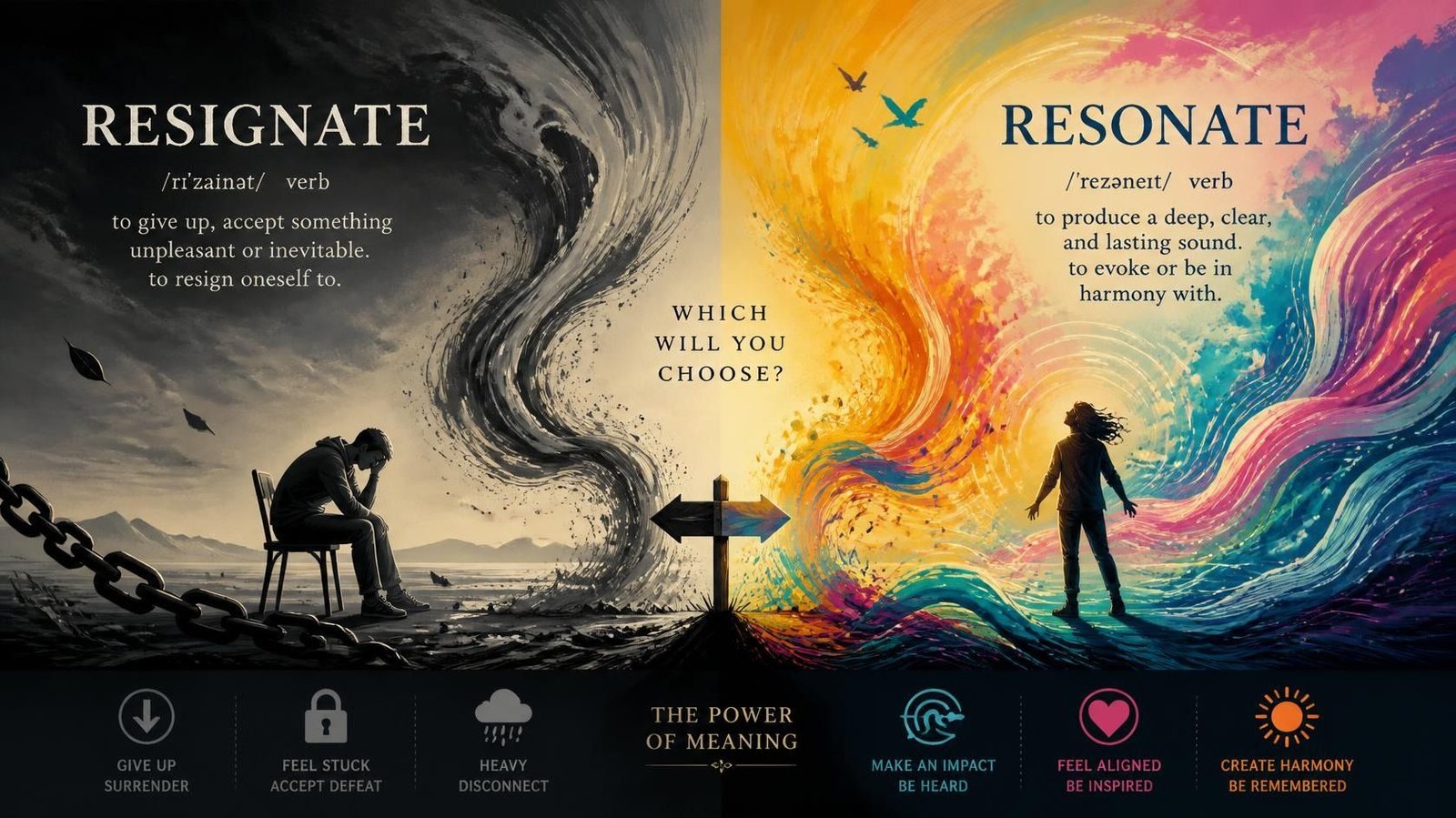

The short answer is simple.
Resonate is the correct word, and resignate isn’t a real English word.
Ever typed “that idea really resignates with me” and then stared at the screen?
Maybe you wondered if your boss or client would notice.
You’re in good company, and the fix takes two minutes.
This guide covers the correct spelling of resonate, why the slip happens, and how to use the word with confidence.
Resignate or Resonate: Why This Mix-Up Happens Everywhere
Search for resignate or resonate and you’ll find thousands of people asking the same thing.
The error pops up in texts, emails, resumes, and even captions.
It feels like a tiny slip.
Still, one wrong word can make a sharp message look rushed.
The Core Mix-Up: What People Think They’re Saying vs. What They Actually Say
Most people want to say a message strikes a chord.
They reach for resonate, but their brain grabs something that sounds like “resign.”
Say both words out loud.
They start with “res” and carry a “z” sound, which is enough to fool your ear.
Why People Keep Using “Resignate” (Even Though It Isn’t a Real Word)
There’s no single cause here.
Several small habits pile up and push people toward the wrong spelling.
Let’s go through them one by one.
You’ll probably spot yourself in at least two.
Phonetic Confusion
English spelling doesn’t always match the sound.
The “z” sound in resonate gets spelled with an “s,” which already trips people up.
Now add a familiar word like “resign” nearby.
Your brain fills in the gap and writes resignate.
Misheard Words
Plenty of us learn words by hearing them first.
In a fast meeting, “resonates” can sound like “re-zig-nates.”
If you’ve never seen the word in print, you’ll guess the spelling.
That guess often lands on the wrong version.
Assumptions About Word Patterns
English has many words that end in “nate,” like “designate” and “dominate.”
So resignate looks like it belongs to that family.
It doesn’t, though.
Pattern guessing works often, but it fails here.
Social Spread
Wrong spellings travel fast online.
One person types resignate in a comment, and ten others copy it without checking.
After a while, the mistake starts to feel normal.
Repetition makes a common spelling error look believable.
Lack of Exposure to the Correct Term
Some people just don’t read or write the word much.
Resonate shows up more in marketing, music, and personal essays than in daily chat.
Less exposure means less memory.
That’s a gap, not a flaw.
Is “Resignate” a Real Word? The Unfiltered Answer
No, it isn’t.
Resignate doesn’t appear in standard English dictionaries, so it counts as an incorrect spelling.
If someone asks “is resignate a word,” the honest answer is a flat no.
Use resonate every time.
Why It Fails Linguistically
A real word needs a root, a meaning, and a place in the language.
Resignate has none of those.
It’s a blend of “resign” and “resonate” with nothing holding it together.
Dictionaries have no entry, and editors will flag it.
Resignate Meaning Explained
Here’s the blunt truth about resignate meaning.
It has no meaning, because the word doesn’t exist.
When people write it, they almost always mean resonate.
Sometimes they mean “resign” or “resignation,” which are different ideas entirely.
Resignate Spelling: Why People Get It Wrong
The resignate spelling feels logical to many writers.
It borrows letters from “resign” and the ending from words like “designate.”
Spell checkers often catch it, but not always.
Typing fast on a phone makes it worse.
The Correct Word: What “Resonate” Actually Means
Resonate is a verb, and it has two main jobs.
One is about sound, and the other is about feeling.
Once you see both, the word clicks.
Let’s break it down.
Core Definitions
In its literal meaning, to resonate is to produce a deep, lasting sound.
Think of a bell or a guitar string that keeps ringing after you touch it.
In its figurative meaning, it’s about connection.
An idea resonates when it feels true or relevant to someone.
Resonate Meaning
Here’s the resonate definition in plain words.
Something resonates when it echoes in your mind or stirs a strong emotional impact.
Another way to say it: it lands.
The message doesn’t just reach you, it stays with you.
Resonate with Someone: What It Really Means
If a story resonates with someone, it matches their own life or beliefs.
They think, “Yes, that’s me.”
That’s why you’ll hear resonate with me meaning a lot in reviews and talks.
It signals a deep connection, not just polite agreement.
Real-World Examples of “Resonate”
A song about leaving home might resonate with a college student far from family.
A speech resonates with listeners when it speaks to a shared worry.
A brand slogan can resonate with a target audience too.
And a cathedral bell resonates through the whole street.
Resignate or Resonate Examples: Correct vs Incorrect Usage
Examples work better than rules.
Seeing both versions side by side makes the difference stick.
Read each sentence out loud.
Your ear will catch the right one fast.
Correct Sentence Examples
- Her honest story resonated with every parent in the room.
- That advice really resonates with me.
- The cello’s low note resonated through the hall.
- Does this headline resonate with your readers?
Incorrect Sentence Examples
- Her honest story resignated with every parent in the room.
- That advice really resignates with me.
- The cello’s low note resignated through the hall.
- Does this headline resignate with your readers?
Quick Comparison Table
| Version | Status | Example |
| Resonate | Correct | The song resonates with me. |
| Resonates | Correct | This quote resonates with many people. |
| Resonated | Correct | Her speech resonated with the crowd. |
| Resignate | Incorrect | The song resignates with me. |
| Resignated | Incorrect | Her speech resignated with the crowd. |
Resonate Synonyms and Similar Words
Good writers don’t repeat one word all day.
Having a few options keeps your writing fresh.
Not every swap fits, though.
Pick the one that matches your meaning.
Common Synonyms of “Resonate”
Here are some solid resonate synonyms and words similar to resonate:
- Strike a chord
- Ring true
- Connect
- Echo
- Reverberate
- Register
When to Use Each Synonym
Use reverberate or echo for sound.
Use strike a chord or ring true when a message feels familiar and honest.
“Connect” works well in casual writing.
“Register” fits when something finally sinks in.
What Dictionaries and Style Guides Say About “Resonate”
Major dictionaries like Merriam Webster, Cambridge, and Oxford list resonate as a standard verb.
They give both the sound meaning and the emotional meaning.
You won’t find resignate in them.
That’s the clearest proof you can get.
Style guides treat resonate with as the natural pairing.
Some editors do call it overused in business writing, so mix in a synonym now and then.
Etymology: How “Resonate” Evolved from Latin to Today
Word history helps you remember spelling.
Once you know where resonate comes from, “resign” stops sounding like a cousin.
The story is short and neat.
Here it is.
Latin Origin
Resonate traces back to the Latin root resonare.
It combines re, meaning “again,” with sonare, meaning “to sound.”
So the word literally means “to sound again.”
That’s why it fits echoes and lasting impressions so well.
Evolution Over Time
The noun resonance came into English first.
The verb form followed later, with dictionaries placing it in the late 1800s.
Over time, people stretched it from sound waves to feelings.
Today the figurative use is far more common than the physical one.
How to Use “Resonate” Correctly in Everyday Life
Knowing the meaning is half the job.
The other half is using it in the right setting.
Tone matters here.
A word that works in a text can feel odd in a legal report.
In Daily Conversation
Keep it light and natural.
“That joke didn’t resonate” is fine, and “This really resonates with me” sounds warm.
Don’t force it into every chat.
Sometimes “I relate to that” does the job.
In Professional Writing
In professional writing, aim for clarity.
“Our product resonates with small business owners” works if you can back it up.
Skip it when you have hard numbers.
“Sales grew 12 percent” beats a vague claim every time.
In Media & Literature
Writers use resonate to describe themes, characters, and music.
A review might say a film’s final scene resonates long after the credits.
It gives critics a way to talk about lasting feeling.
Just don’t stack it three times in one paragraph.
Correct vs Incorrect Usage
Always spell it r-e-s-o-n-a-t-e.
Add endings the normal way: resonates, resonated, resonating.
Never swap in resignate.
If your spell checker underlines it, trust the red line.
Resonate Pronunciation, Verb Forms, and Past Tense
The resonate pronunciation is REZ-uh-nayt.
Stress the first syllable, and the “z” sound lands where you’d expect.
Here’s a quick forms list:
- Resonate (base form)
- Resonates (third person)
- Resonated (past tense)
- Resonating (present participle)
- Resonance (noun)
The past tense of resonate is resonated.
There’s no irregular form to memorize.
Writing Messages That Truly Resonate
Now for the fun part.
Knowing the word is good, and making your writing resonate is better.
These six habits work for emails, posts, speeches, and ads.
Try one at a time.
Know Your Audience
Before you write, picture one real reader.
What’s keeping them up at night?
A message for new parents sounds different than one for engineers.
Match their worries, not yours.
Speak to Emotions
People remember how a message made them feel.
Facts help, but feeling is what sticks.
Say “you’ll stop dreading Monday mornings.”
That beats “improves workflow efficiency.”
Keep It Clear
Clear writing wins every time.
If a ten year old can’t follow it, trim it.
Short words, short sentences, one idea at a time.
Your reader will thank you.
Use a Strong Hook
Your first line decides if people stay.
Open with a question, a surprise, or a small confession.
“I once sent an email with the wrong name on it” pulls readers in.
Then deliver on the promise.
Add Sensory Details
Details make ideas feel real.
Don’t say “the café was nice,” say “it smelled like cinnamon and burnt toast.”
Readers can see, hear, and smell that.
That’s how you create a shared meaning fast.
Be Authentic
People can sense a fake tone from a mile away.
Write like you talk, mistakes and all.
Honest beats polished.
That’s what builds trust.
Communication Tips to Make Your Messages Resonate
Let’s add a few more tools.
These work like seasoning, so a pinch is plenty.
Use Storytelling
A short story carries a point better than a list of facts.
Share a moment, a problem, and what changed.
Keep it under five sentences.
Then link it to your main idea.
Use Concrete Examples
Vague claims slide right past readers.
“Saves time” means little, but “cuts your weekly report from two hours to twenty minutes” sticks.
Numbers and names make ideas feel solid.
Use them whenever you have them.
Use Rhythm
Mix short and long sentences.
Short ones punch, and longer ones let you explain.
Read your draft aloud.
If you stumble, rewrite that line.
Use Contrast
Contrast makes a point pop.
“Fast isn’t always better, but slow never wins.”
Pairing two opposite ideas sharpens your message.
Use it sparingly, though.
Avoid Jargon
Jargon builds a wall between you and your reader.
Unless everyone in the room uses a term, swap it for plain talk.
Say “start” instead of “initiate.”
Say “use” instead of “leverage.”
Use Active Verbs
Active verbs give your writing energy.
“The team built the app” beats “The app was built by the team.”
They’re shorter and clearer too.
Your message hits harder.
Table: What Creates Resonance vs. What Kills It
| Creates Resonance | Kills Resonance |
| Real stories | Empty claims |
| Specific details | Vague phrases |
| Plain words | Heavy jargon |
| Honest tone | Forced hype |
| Active verbs | Passive sentences |
| One clear idea | Too many points |
Practice: Exercises to Master “Resonate”
Reading is one thing, practice is another.
These quick drills lock the word in.
Grab a pen or open your notes app.
It takes about three minutes.
Fill-in-the-Blank
Pick the correct word: resonate or resignate.
- Her words _____ with everyone in the audience.
- Does this logo _____ with younger buyers?
- The speech _____ long after it ended.
Answers: 1. resonate (or resonated if past tense fits your sentence), 2. resonate, 3. resonated.
Every correct answer uses a form of resonate.
Rewrite the Sentence
Fix these sentences:
- “That quote resignates with me.”
- “The message resignated with our readers.”
Corrected: “That quote resonates with me.”
And: “The message resonated with our readers.”
FAQs About Resignate or Resonate
What is the difference between resignate and resonate?
Resonate is a real verb about sound and emotional connection.
Resignate has no meaning because it isn’t a word.
Is resignate a real word in English?
No, it isn’t.
It’s a common spelling error for resonate.
What does resonate mean in simple words?
It means to ring out or to strongly connect.
A message that resonates feels true to you.
What does it mean when something resonates with you?
It means the idea matches your own thoughts or experience.
You feel understood by it.
How do you use resonate in a sentence?
“Her story resonated with me because I’d lived something similar.”
Add “with” plus the person or group.
What is the past tense of resonate?
It’s resonated.
You just add “d.”
What are some common synonyms for resonate?
Try strike a chord, ring true, echo, connect, or reverberate.
Pick based on tone and meaning.
Why do people mistakenly say resignate?
The sound is close to “resign,” and “nate” endings feel familiar.
Wrong spellings also spread online.
Is it correct to say “that resonates with me”?
Yes, it’s correct and widely used.
It’s fine in speech and in most writing.
What is the origin of the word resonate?
It comes from the Latin resonare, meaning “to sound again.”
The verb entered English in the late 1800s.
Conclusion
Here’s what to remember.
Resonate is the right word, and resignate is a spelling slip.
Next time your fingers type the wrong one, you’ll catch it.
A good habit is to read your draft aloud before hitting send.
Did this clear things up for you?
Drop a comment with the word you always second guess, and share this guide with a friend who writes a lot.

