
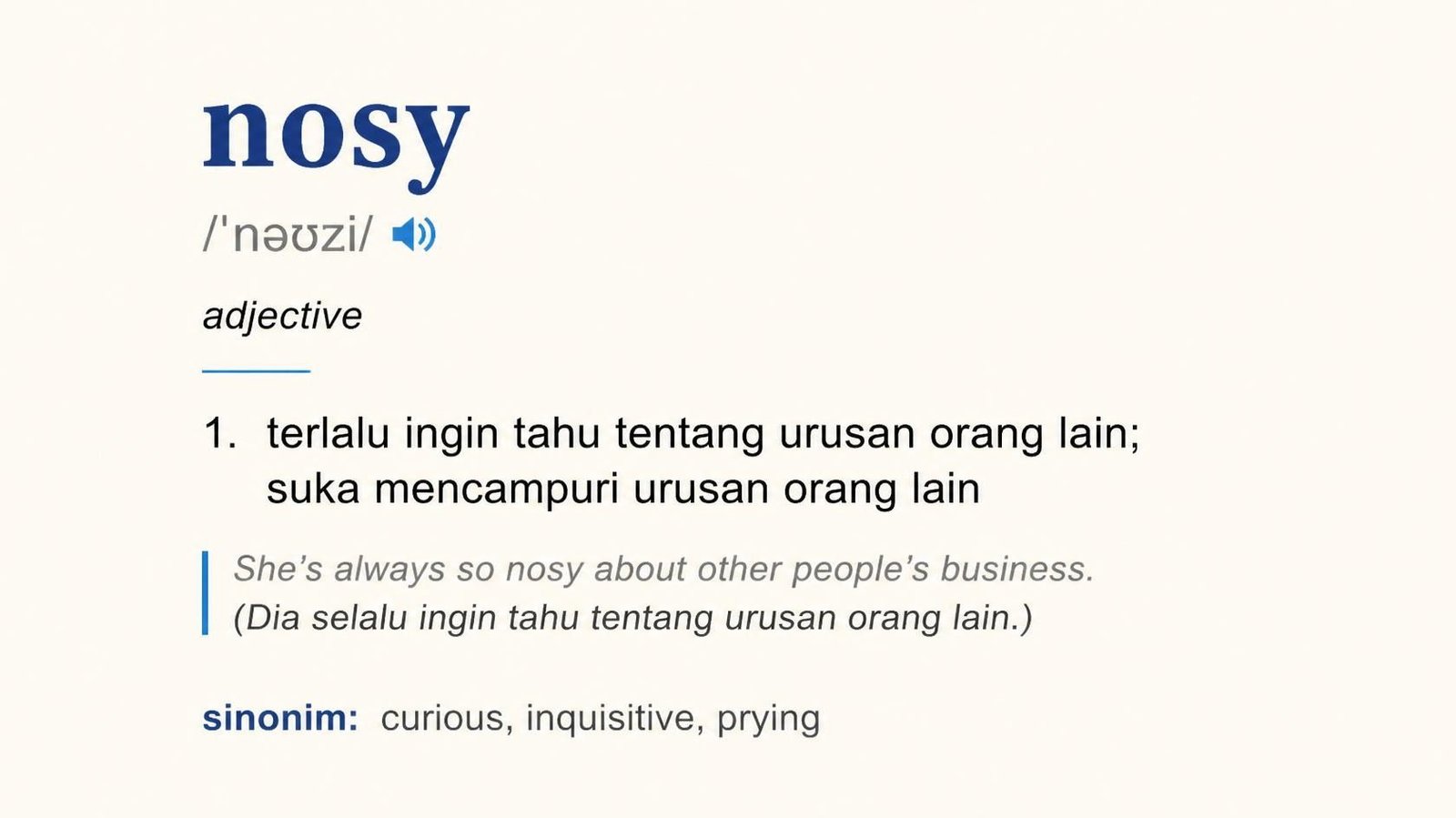

The word “nosy” means being too curious about other people’s private lives or personal matters. It describes someone who asks too many questions, wants to know things that do not concern them, or interferes in other people’s business. In Indonesian, “nosy” is similar to kepo or suka ikut campur urusan orang lain.
For example, if someone keeps asking about your relationship, salary, family problems, or private messages, you might call that person nosy. The word is informal and usually has a negative meaning. However, its tone can sometimes be playful when friends use it jokingly.
What Does Nosy Mean?
“Nosy” is an adjective used to describe a person who shows excessive interest in other people’s affairs. A nosy person may ask personal questions without considering whether the other person feels comfortable answering them.
For example, imagine that you are talking to a friend about your weekend. Another person suddenly asks how much money you spent, who you went with, and why you did not invite them. If those questions feel intrusive, you might describe that person as nosy.
The word can also describe behavior rather than someone’s entire personality. A person who is normally respectful might occasionally ask an inappropriate question out of curiosity. In that situation, you could say that the person is being nosy.
Simple Definition of Nosy
The simplest definition of nosy is being too interested in things that are private or none of your business.
Here are some simple examples:
- She is always asking about my personal life. She is so nosy.
- Stop being nosy and let me handle my own problems.
- My neighbor is nosy and wants to know everything about everyone.
- I do not want to answer such a nosy question.
Origin of the Word Nosy
The word “nosy” comes from the word “nose.” Historically, the expression is associated with the idea of poking one’s nose into other people’s business.
The suffix “-y” helps form an adjective, so “nosy” describes someone who behaves as though they are putting their nose where it does not belong. The spelling “nosey” is also used, although “nosy” is the more common standard spelling.
Over time, the word developed its familiar meaning of being overly curious about other people’s private affairs. Today, it appears frequently in everyday conversations, social media posts, text messages, and informal writing.
Nosy Meaning in Chat and Text Messages
In texting, “nosy” usually means that someone is asking questions that feel too personal or trying to discover information that the other person does not want to share.
People often use the word in casual conversations with friends, family members, or coworkers. Its exact meaning depends on the situation and the relationship between the people involved.
For example:
Person A: Who were you talking to last night?
Person B: Why do you want to know?
Person A: I’m just curious.
Person B: Don’t be so nosy!
In this conversation, the speaker uses “nosy” because the other person is asking about something personal.
Common text-message examples include:
- “You’re being nosy 😂” — a playful way to say someone is asking too many questions.
- “Stop being nosy lol.” — a casual request to stop asking personal questions.
- “That’s none of your business. Don’t be nosy.” — a stronger response that sets a boundary.
- “I’m not nosy; I’m just curious.” — a response from someone who does not think their questions are inappropriate.
Examples of Nosy in Everyday Conversations
Understanding examples makes it easier to use “nosy” correctly.
1. Talking About Relationships
Someone repeatedly asks whether you are dating, who your partner is, or why you broke up with someone.
Example: “Why are you asking so many questions about my relationship? You’re being nosy.”
2. Discussing Money
A coworker keeps asking how much you earn or how much you paid for something.
Example: “I don’t usually discuss my salary. That’s a little nosy.”
3. Asking About Family Matters
A neighbor wants details about an argument between your family members.
Example: “Our family matters are private, so please don’t be nosy.”
4. Looking at Someone’s Phone
A person tries to read your messages without permission.
Example: “Don’t be nosy. My phone is private.”
5. Asking Questions as a Joke
A close friend asks too many questions about your weekend plans.
Example: “You’re so nosy! I’ll tell you everything later.”
In this last example, the word is used playfully rather than angrily.
Is Nosy a Negative Word?
Yes, “nosy” is generally a negative word because it suggests that someone is crossing personal boundaries. It can make a person sound intrusive, interfering, or disrespectful of privacy.
However, the word does not always express serious anger. Friends may use it jokingly when someone wants to know a secret or asks about a surprise party.
The tone, facial expression, and relationship between the speakers help determine whether “nosy” is meant as an insult or a friendly tease.
If you want to sound more polite, you can say:
- “That’s a little personal.”
- “I’d rather keep that private.”
- “I’m not comfortable discussing that.”
- “Can we talk about something else?”
These expressions communicate your boundaries without directly calling someone nosy.
Nosy vs. Curious: What Is the Difference?
“Nosy” and “curious” both describe an interest in learning something, but they have different meanings.
| Word | Meaning | Typical Tone |
| Nosy | Too interested in other people’s private matters | Usually negative |
| Curious | Wanting to learn or understand something | Usually neutral or positive |
| Inquisitive | Eager to ask questions and gain knowledge | Often positive |
| Intrusive | Interfering with someone’s privacy or personal space | Negative |
| Interested | Wanting to know more about a subject | Usually neutral |
For example, asking a teacher how a scientific experiment works is curious behavior. Repeatedly asking a classmate about a private family problem may be considered nosy.
The main difference is respect for boundaries. Curiosity can be healthy and helpful, while nosiness can make other people uncomfortable.
Synonyms and Antonyms of Nosy
Learning similar and opposite words can improve your English vocabulary.
Synonyms
- Intrusive: Interfering in someone’s private life.
- Inquisitive: Eager to ask questions or discover information.
- Meddlesome: Frequently interfering in other people’s affairs.
- Prying: Trying to discover private information.
- Curious: Wanting to know or learn something, though it is not always negative.
Not every synonym has exactly the same meaning. For example, “curious” is often positive, while “prying” usually suggests an invasion of privacy.
Antonyms
- Respectful: Showing consideration for other people.
- Discreet: Careful about private or sensitive information.
- Unintrusive: Not interfering with other people.
- Reserved: Not asking for or sharing much personal information.
- Private: Keeping personal matters to oneself.
How to Use Nosy in a Sentence
“Nosy” is an adjective, so it commonly appears after linking verbs such as “be,” “seem,” or “become.” It can also come before a noun.
Examples:
- My aunt is very nosy about my future plans.
- That was a nosy question to ask a stranger.
- Please do not be nosy about my personal life.
- Our nosy neighbor always watches what everyone is doing.
- I know you are curious, but you do not have to be nosy.
- He seemed nosy when he kept asking about my private conversation.
- I do not like nosy people who refuse to respect boundaries.
- She was being nosy when she read someone else’s messages.
A useful expression is “mind your own business.” It means that someone should focus on their own affairs instead of interfering in someone else’s life.
Example: “Please mind your own business and stop asking personal questions.”
Nosy on Social Media
On social media, “nosy” is often used in comments, captions, memes, and private messages. People may use it when someone asks about a relationship, investigates a personal story, or wants details about an event.
For example, a person might post, “Some of you are too nosy about my life.” This means they feel that other people are paying too much attention to their personal affairs.
A playful caption could be, “My friends are nosy, but they always know the latest gossip.” Here, the speaker uses humor to describe friends who love hearing personal news.
However, calling someone nosy in a public comment can sound rude or confrontational. If you want to avoid an argument, it may be better to answer politely or keep the information private.
Frequently Asked Questions
1. What does nosy mean in simple words?
Nosy means being too curious about other people’s private lives or asking questions that are not your business.
2. Does nosy mean kepo in Indonesian?
Yes. In many everyday situations, “nosy” is similar to kepo, especially when someone asks too many personal questions or interferes in other people’s affairs.
3. Is nosy an insult?
It can be. “Nosy” is usually negative, but friends sometimes use it jokingly. The meaning depends on the speaker’s tone and context.
4. What is an example of a nosy person?
A person who constantly asks about your salary, relationship, family problems, or private conversations may be described as nosy.
5. What is the difference between nosy and curious?
Curious means wanting to learn something, while nosy means showing excessive interest in matters that may be private or none of your business.
6. How do you respond when someone is nosy?
You can politely say, “I’d rather keep that private,” or “That’s personal, and I don’t want to discuss it.”
7. Is it nosy or nosey?
Both spellings exist, but “nosy” is the more common standard spelling in modern English.
Final Thoughts
The word “nosy” describes someone who is overly interested in other people’s personal matters. It is commonly used in everyday English, text messages, and social media conversations. In Indonesian, its closest everyday equivalent is often kepo or suka ikut campur urusan orang lain.
Remember that being curious is not always a bad thing. Asking questions can help you learn, understand people, and build relationships. However, asking personal questions without permission or ignoring someone’s boundaries can make you seem nosy.
Use “nosy” when you want to describe excessive curiosity, and remember to consider the context before using it about another person. Respecting privacy is an important part of healthy communication.

