

Have you ever wondered whether to write passtime or pastime? You are not alone. Many people get confused because English contains plenty of words with double letters, and “passtime” may look correct at first glance.
However, there is only one standard spelling for the noun that describes an enjoyable activity during your free time. The correct word is pastime, with just one “s” in the middle. “Passtime” is a common spelling mistake that you should avoid in essays, emails, social media posts, and professional documents.
Understanding the correct spelling of pastime is simple once you learn its meaning and remember a helpful spelling trick. In this guide, you will discover the definition, origin, common mistakes, and practical examples of using the word naturally.
Quick Answer
The correct spelling is pastime, not passtime. A pastime is a hobby, recreational activity, or enjoyable way to spend your free time.
For example, “Reading novels is my favorite pastime” is correct. Writing “Reading novels is my favorite passtime” is incorrect in standard English.
Remember that pastime contains only one “s.” You can use it when discussing hobbies, entertainment, sports, creative activities, or anything you enjoy doing in your spare time.
Meaning of “Pastime”
The word pastime means an activity that someone enjoys doing for relaxation, pleasure, or entertainment. It usually refers to something people choose to do outside their main responsibilities, such as work, school, or household tasks.
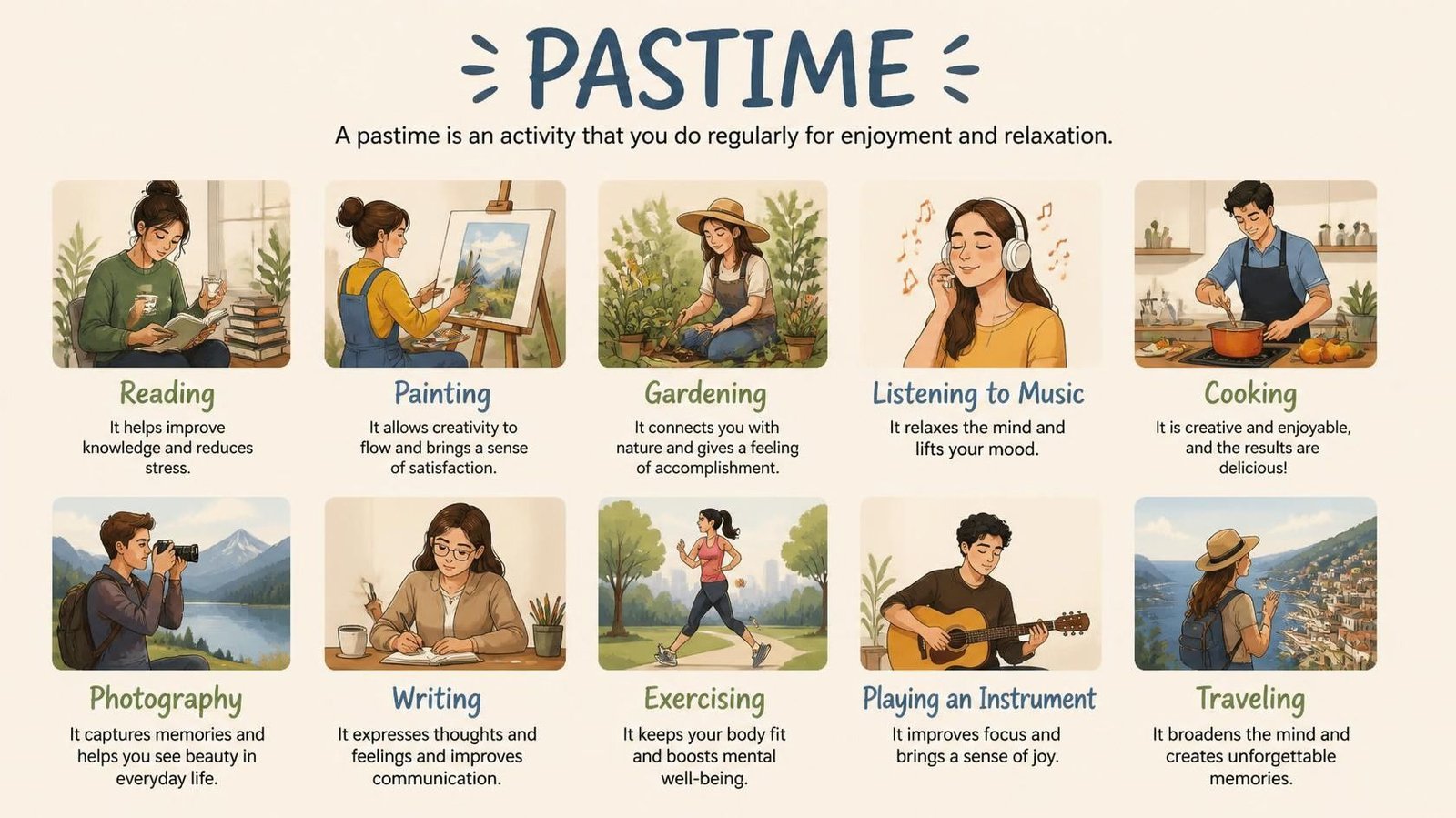
Reading, gardening, painting, cooking, fishing, and playing chess are common examples of pastimes. Some activities help people develop new skills, while others simply provide a pleasant break from everyday routines.
For example, someone might say, “Gardening is my favorite pastime because it helps me relax after work.” Another person might explain, “Playing basketball is a weekend pastime I share with my friends.”
Both sentences use the word correctly. A pastime does not have to be expensive, complicated, or productive. The main idea is that the activity brings enjoyment and makes leisure time more satisfying.
Pastime vs. Hobby
The words pastime and hobby have similar meanings, but their usage can differ slightly. A hobby often suggests a regular interest that someone actively develops, such as photography, knitting, collecting coins, or learning an instrument.
A pastime can describe almost any enjoyable way to spend time, whether it is a serious interest or an occasional activity. Watching a movie on Sunday afternoon can be a pastime, even if someone does not consider watching movies a personal hobby.
In everyday conversation, the two words are often interchangeable. You can say, “Photography is my hobby,” or “Photography is my favorite pastime,” without changing the basic message.
Why People Misspell “Passtime or Pastime”
People often search for passtime or pastime because the incorrect version looks familiar. The word “pass” contains a double “s,” so some writers assume that combining it with “time” should produce “passtime.”
English spelling does not always follow a predictable pattern. Words such as “address,” “success,” and “misspell” contain double letters, which may encourage people to apply the same pattern to unrelated words.
Another reason is typing too quickly. When people write messages, comments, or social media captions, they may choose a spelling based on how a word sounds rather than checking its written form.
The confusion becomes easier to understand when you consider the phrase “pass time.” Although these words appear separately in that expression, the noun for an enjoyable leisure activity is written as one word: pastime.
The best way to avoid this common misspelling is to memorize the standard form and recognize it when reading. If you are unsure, check a reliable English dictionary or use a proofreading tool before publishing important writing.
Origin of “Pastime”
The word pastime has a long history in English. It developed from the idea of passing time pleasantly, referring to activities that make spare time enjoyable rather than dull or unproductive.
Its historical development is connected with the verb “pass” and the noun “time.” Over the centuries, English speakers adopted “pastime” as a single word for recreation, amusement, and leisure activities.
The term has been used for centuries to describe games, hobbies, and other enjoyable pursuits. Although entertainment has changed considerably, the basic meaning of the word remains familiar today.
Understanding its origin can also help you remember the spelling. Think of a pastime as something that helps you pass time pleasantly. The phrase contains “pass,” but the established noun is spelled pastime, with one “s” in the middle.
British vs American English
Some English words have different spellings in British and American English. For example, “colour” is common in British English, while “color” is standard in American English.
However, pastime is spelled the same way in both varieties. The correct form remains “pastime” in the United States, the United Kingdom, Canada, and Australia.
| English variety | Correct spelling | Incorrect spelling |
| American English | Pastime | Passtime |
| British English | Pastime | Passtime |
| Canadian English | Pastime | Passtime |
| Australian English | Pastime | Passtime |
There is no regional spelling rule that makes “passtime” correct. Whether you are writing a school assignment in the United States or a business email in the United Kingdom, use pastime.
If you are editing an article for an international audience, you do not need to change this word to match a particular English variety. Its spelling stays consistent.
When to Use “Pastime”
Use pastime when you want to describe an enjoyable activity people do during their leisure time. It works in casual conversations, educational writing, workplace communication, blog posts, and other situations where you discuss interests or recreation.
For instance, you could write, “Cycling has become a popular pastime in my neighborhood.” You could also say, “Her favorite pastime is creating handmade greeting cards.”
The word works with individual activities and broader interests. It can describe something relaxing, creative, social, physical, or entertaining, depending on the context.
You can also use its plural form, pastimes, when discussing several activities. For example, “His favorite pastimes include reading, hiking, and playing the guitar.”
Common Situations
You can use pastime in a wide range of everyday situations. The following examples show how naturally it fits different types of writing.
- School assignments: “My favorite pastime is drawing pictures of animals.”
- Emails: “Reading is a relaxing pastime after a busy day.”
- Work reports: “The survey explored employees’ favorite leisure activities and pastimes.”
- Social media: “Hiking has become my favorite weekend pastime.”
- Daily conversation: “What do you usually do for fun in your free time?”
In each example, the word refers to an activity that provides enjoyment. Choose it whenever you want a slightly more descriptive alternative to the general word “activity.”
Remember that pastime is a noun. If you want to describe the action of using time, the phrase “pass time” may be more suitable. The correct choice depends on the sentence’s meaning and grammatical structure.
Common Mistakes
One of the most frequent errors is writing passtime instead of pastime. Although the incorrect form may appear in informal messages or online searches, it is not the standard spelling of the noun.
Another mistake is writing “past-time” with a hyphen. In ordinary modern English, the noun is written as one word without a hyphen.
Writers also sometimes confuse pastime with pass time. These expressions are related in meaning, but they serve different grammatical purposes.
A pastime is an activity, while “pass time” describes what someone does to occupy a period. For example, “Crossword puzzles are a favorite pastime” is correct, as is “I solve crossword puzzles to pass time while traveling.”
Correct vs Incorrect Examples
Compare these examples to see the spelling difference clearly.
| Incorrect or different form | Correct usage |
| Reading is my favorite passtime. | Reading is my favorite pastime. |
| Swimming is a healthy passtime. | Swimming is a healthy pastime. |
| Painting is her favorite past-time. | Painting is her favorite pastime. |
| My favorite passtime is cooking. | My favorite pastime is cooking. |
The phrase “pass time” is not always incorrect. It is appropriate when used as a verb phrase, such as “I play word games to pass time during long trips.”
Likewise, “past time” can be correct in a different sentence, such as “It is past time to leave.” In that example, “past” and “time” do not form the noun meaning a hobby.
A useful proofreading habit is to check whether you are naming an enjoyable activity or describing how you occupy time. That small distinction will help you choose the right expression.
Everyday Examples
Seeing pastime in realistic sentences makes its meaning easier to understand. The word can describe simple activities, long-term interests, and enjoyable routines that fit into everyday life.
For example, reading before bed may be someone’s favorite pastime, while another person may enjoy baking on weekends. Neither activity needs to produce a particular result to qualify as a pastime.
Here are examples of how you can use the word in different communication settings.
Emails
In personal and professional emails, pastime can help you discuss interests politely and clearly.
Example: “During my free time, reading historical novels is my favorite pastime.”
You could also write, “One of my favorite pastimes is exploring new hiking trails with my family.” Both sentences are appropriate when sharing personal interests.
Social Media
Social media captions often describe hobbies, leisure activities, and memorable experiences. Pastime can make a caption sound more descriptive without being overly formal.
Example: “Photography is more than a hobby for me. It is my favorite pastime and a way to capture beautiful moments.”
Another example is, “Weekend cycling has become my favorite pastime.” Use the word naturally rather than adding it simply to make a caption sound sophisticated.
Professional Writing
In professional documents, pastime may appear in employee profiles, biographies, surveys, and discussions about work-life balance.
Example: “The employee survey identified reading, gardening, and exercise as popular pastimes.”
You might also write, “The company encourages employees to maintain interests and pastimes outside working hours.” In these contexts, the word helps communicate the idea of leisure and personal interests clearly.
School Assignments
Students may use pastime in essays about personal interests, hobbies, or how they spend their free time.
Example: “My favorite pastime is playing badminton because it keeps me active and gives me an opportunity to spend time with friends.”
Another sentence could be, “Drawing is a creative pastime that helps me express my ideas.” These examples are simple, grammatically correct, and suitable for school writing.
Usage Comparison Table
The following table summarizes the difference between the correct spelling, the common misspelling, and related expressions.
| Word or phrase | Meaning | Example |
| Pastime | An enjoyable leisure activity | Reading is my favorite pastime. |
| Passtime | A nonstandard misspelling | Write “pastime,” not “passtime.” |
| Pass time | To occupy a period | I listen to music to pass time. |
| Past time | Time that has already passed, or part of another expression | It is past time to start. |
| Pastimes | More than one leisure activity | Her pastimes include painting and gardening. |
The most important distinction is between pastime and pass time. The first names an activity, while the second describes an action.
If you remember that difference, you will be less likely to confuse the expressions when writing essays, messages, articles, or workplace documents.

