

Ever frozen mid-email, wondering if you should type “putted” or “put”?
You’re not alone, and it happens to native speakers too.
The short answer is put.
The past tense of put is put, and the past participle of put is also put.
Is It “Putted” or “Put”? (Quick Answer You Can Trust)
In standard English, you say “put” for the past tense.
“Putted” isn’t the right form for everyday writing, speaking, or exams.
Put is an irregular verb, so it skips the usual adding -ed step.
It looks the same in the present and the past, and context tells you which is which.
Examples:
- I put the keys in the drawer yesterday. (past)
- I put the keys in the drawer every night. (present habit)
- She has put the report on the desk. (present perfect)
Why “Putted” Sounds Right (But Isn’t)
Most English verbs follow a simple pattern.
Walk becomes walked, and jump becomes jumped.
So your brain expects put to become “putted.”
It feels logical, even if it’s wrong.
Why this happens:
Linguists call this overgeneralization.
Your brain spots a pattern and applies it everywhere, even where it doesn’t belong.
Kids do it all the time with words like “goed” and “runned.”
Adult English language learning brings the same trap, especially with short verbs.
Is “Putted” Ever Correct? Yes, But Only in Golf
Here’s the twist that confuses people.
“Putted” is a real word, but it belongs to a different verb.
That verb is putt, a golf stroke where you tap the golf ball along the putting green toward the hole.
Since putt is a regular verb, its past tense is putted.
Key difference:
- Put means to place something somewhere.
- Putt means to hit a golf ball gently with a putter.
Example:
He putted from 12 feet and sank a birdie on the last hole.
The ball rolled across the golf course green and dropped in.
Why this matters:
If you write “I putted my phone on the table,” a reader will picture a golfer with a phone.
Using the right word keeps your correct word usage sharp and your meaning clear.
Understanding the Verb Forms of “Put”
The verb put has four forms, and three of them are identical.
That’s why people trip over it.
Learning the English verb forms one by one makes it feel much less messy.
Think of it as one word wearing a few different hats.
Base Form
The base form of put is “put.”
You use it for the infinitive (“to put”) and the present tense of put with I, you, we, and they.
Example: You put the files away after lunch.
Past Tense
The simple past tense is also “put.”
There’s no change at all.
Example: I put the documents in the folder an hour ago.
Past Participle
The past participle of put is “put” too.
You use it with auxiliary verbs like have, has, and had, and in the passive voice.
Example: The report was put together by the whole team.
Present Participle
The present participle of put is “putting.”
You use it for continuous action.
Example: She is putting the phone on the table right now.
Full Conjugation Table of “Put”
A quick table helps you see the whole picture.
This is the verb conjugation at a glance.
| Tense | Example |
| Simple present | I put / she puts |
| Simple past | I put |
| Present perfect | I have put / she has put |
| Past perfect | I had put |
| Present continuous | I am putting |
| Passive voice | It was put on the shelf |
Notice that only third person singular adds an “s” in the present: puts.
Everything else stays as “put,” apart from the “ing” form.
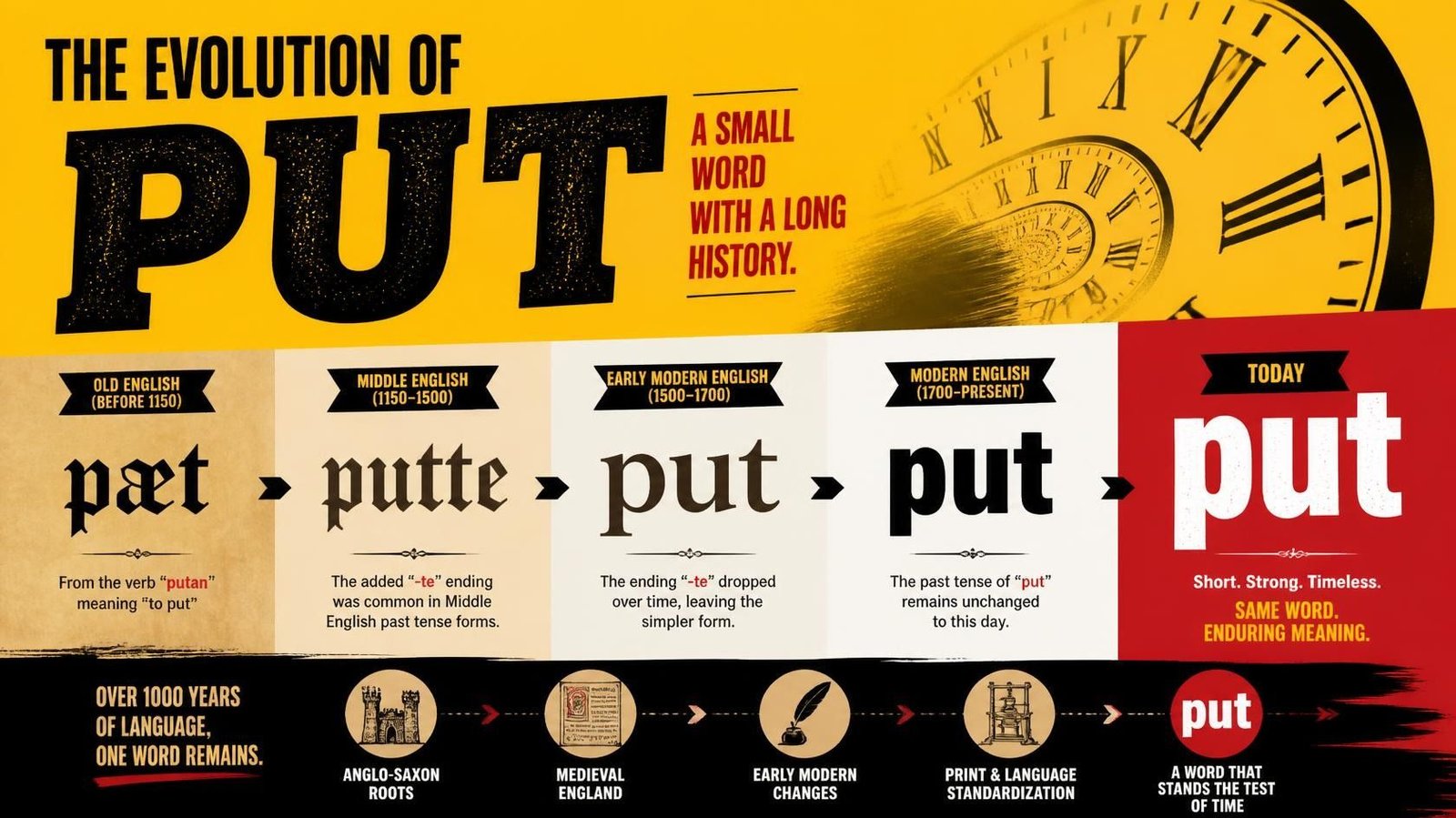
Why Doesn’t “Put” Change in the Past Tense?
If you’ve ever asked “why doesn’t put change in the past tense,” you’ve asked a smart question.
The answer comes from how English grew over centuries.
Short verbs ending in a “t” sound often lost their old endings over time.
What’s left is a word that sounds the same now and then.
Simple explanation:
Old verb endings wore down as the language changed.
Put kept its shape and dropped the extra baggage.
So there’s no hidden rule you’re missing.
It’s just a past tense exception that you learn once and keep.
Other Verbs That Don’t Change in the Past Tense
Put isn’t alone in this group.
Many irregular past tense verbs look the same in all three main forms.
Learning them as a family makes them easier to remember.
You also get a bonus: fewer common grammar errors in your writing.
Common examples:
- Cut: I cut the paper.
- Hit: He hit the ball.
- Let: She let me borrow it.
- Set: We set the table.
- Hurt: That hurt a lot.
- Cost: It cost twenty dollars.
- Quit: He quit his job.
- Shut: They shut the door.
Quick insight:
Many of these verbs are short and end in “t” or “d.”
Watch out, though, because go and run don’t belong here, since they become went and ran.
Common Mistakes With “Put” (And How to Fix Them)
Most errors with put come from three habits.
Spot them early and you’ll fix them fast.
Here’s a quick guide to the grammar mistakes I see most often.
Each one has a simple fix.
Adding “-ed” Automatically
Wrong: I putted the bag on the chair.
Right: I put the bag on the chair.
Your brain wants the “-ed” ending, so pause and ask if the verb is irregular.
With put, the answer is always yes.
Confusing Perfect Tense
Wrong: She has putted the keys away.
Right: She has put the keys away.
The perfect tense needs the past participle, and for put that’s “put.”
Same trick, same fix.
Mixing “Put” and “Putt”
Wrong: He put from 10 feet and made the shot.
Right: He putted from 10 feet and made the shot.
If a golf ball is involved, you want putt.
For anything else, you want put.
Real-World Examples of “Put” in Context
Rules are useful, but examples make them stick.
Here are sentence examples from real situations.
Read them out loud and notice how natural they sound.
That’s the best proofreading test you have.
Everyday Conversation
- I put the phone on the table and forgot about it.
- Did you put the keys in the drawer?
- We put away the dishes before the guests arrived.
Workplace Use
- I put the report on the desk this morning.
- She put off a meeting until Friday.
- He put forward an idea that saved the project.
These lines fit professional emails well.
They sound clear and neutral.
Academic Writing
- The researchers put the sample through three tests.
- The proposal was put to a vote.
In academic writing, you’ll see put in the passive voice a lot.
The form never changes, so you can use it with confidence.
Quick Memory Trick to Avoid “Putted”
Here’s a trick that works like a charm.
Say it with the golf test: “Is there a golf ball involved?”
If yes, use putted.
If no, use put, every single time.
You can also remember this: put is the same word in three tenses.
Today, yesterday, and “have done” all use one spelling.
“Put” in Phrasal Verbs (Very Important for Fluency)
Put is one of the busiest verbs in English.
Pair it with a small word, and it takes on new meanings.
Since put never changes in the past, these phrases stay easy.
You only need to learn the meaning, not extra spellings.
Common Examples:
- Put on a jacket: She put on a jacket before leaving.
- Put out a fire: The crew put out the fire fast.
- Put up with noise: I put up with the noise all night.
- Put off a meeting: We put off the meeting.
- Put down a box: He put down the box carefully.
- Put away the dishes: They put the dishes away.
Why this matters:
Native speakers use these phrases all day.
Knowing them helps your English fluency and makes your speech sound natural.
Pronunciation Notes: “Put” vs “Putt”
Spelling isn’t the only difference here.
The two words also sound different, which helps with spelling and pronunciation.
Say them out loud and you’ll feel it.
One has a short, soft vowel, and the other has a punchier one.
Key difference:
- Put rhymes with “foot.”
- Putt rhymes with “but.”
Why it matters:
Many learners say both words the same way.
That blurs the put and putt difference and can confuse listeners.
Practice with pairs: “put it” and “putt it.”
After a few rounds, your ear will pick up the gap.
Case Study: Why Learners Overcorrect “Put”
Here’s a simple, made-up example based on a common pattern.
It shows how smart learners still land on the wrong form.
Picture a learner named Sara.
She studies grammar for English learners every evening.
Scenario
Sara learns that regular verbs take “-ed.”
She then writes, “Yesterday I putted my laptop in my bag.”
What went wrong
Sara applied a regular verb rule to an irregular verb.
She trusted the pattern recognition that usually helps her.
Result
Her teacher circled the word and explained the exception.
Sara now keeps a short list of verbs like put, cut, and set on her desk.
Mistakes like this show real progress.
You only overcorrect once you’ve learned the rule.
Why English Still Has Irregular Verbs
Irregular verbs can feel like a prank.
They have a real story, though.
Short answer: history
English grew from Old English, with strong influence from Old Norse and other languages.
Over time, many old verb patterns faded, while the most common verbs held onto their odd forms.
That’s why everyday words like put, go, and be stay irregular.
People use them so often that they never got “fixed.”
Advanced Grammar Insight: Strong vs Weak Verbs (Simplified)
Grammar experts split verbs into two big groups.
Weak verbs add an ending like “-ed,” as in walk and walked.
Strong verbs change an inside vowel, as in sing, sang, sung.
Put is a quirky case because it doesn’t add anything and doesn’t change a vowel.
You don’t need to memorize the theory.
Just know that irregular verb patterns come in a few flavors, and put is the “stays the same” one.
Comparison: Put vs Similar Irregular Verbs
Seeing put next to its cousins helps a lot.
Here’s a simple look at how they behave.
| Verb | Present | Past | Past participle |
| Put | put | put | put |
| Cut | cut | cut | cut |
| Set | set | set | set |
| Hit | hit | hit | hit |
| Go | go | went | gone |
| Run | run | ran | run |
The first four never change, which makes them friendly.
Go and run need extra care.
Practical Writing Tips to Master “Put”
A few small habits will lock this in.
They take under a minute to practice.
- Say the sentence out loud before you hit send.
- Add a time word like “yesterday” to check the tense.
- Ask the golf question: is a ball involved?
- Keep a short list of verbs that stay the same in past tense.
- Reread professional emails once for common grammar errors.
You’ll also stay out of trouble by checking context.
“I put it there” can mean now or then, so clear time words help your reader.
Quick FAQs About “Putted” and “Put”
Is it put or putted?
Use put. It’s the correct past tense for placing something.
Is putted a real word?
Yes, but only as the past tense of putt in golf.
What is the past participle of put?
It’s put, as in “I have put it away.”
What are the four forms of the verb put?
They are put, put, put, and putting, plus “puts” for third person singular.
How do you use put in a sentence?
Try this: “I put the report on the desk.”
Conclusion
So, putted or put? The answer is put for nearly every situation you’ll face.
Save putted for golf, where putt is a different verb altogether.
Now you know the verb forms, the common mistakes, and a simple memory trick.
Your emails, essays, and chats will sound cleaner right away.

