
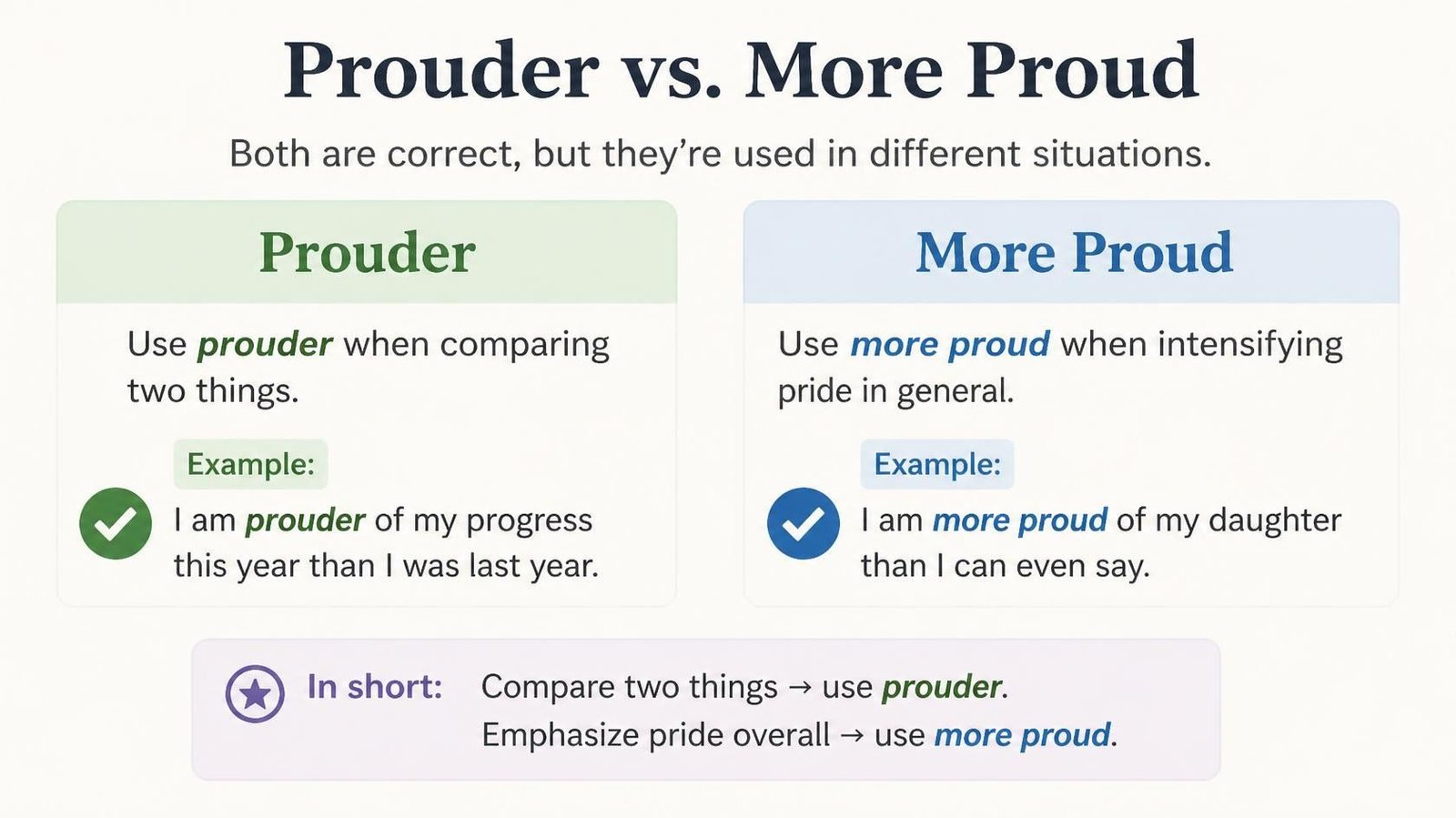

Prouder is the standard comparative form of proud.
More proud shows up too, mostly in speech and a few set phrases, but prouder is the safe pick in formal English.
You probably froze while typing a message to someone you love.
Should it say “I couldn’t be prouder” or “I couldn’t be more proud”?
Both can work, and this guide shows you when.
You’ll get the rule, real examples, common slips, and a quick quiz at the end.
Why “More Proud” vs Prouder Confuses So Many People
Proud is a short word, so the usual rule says add er.
Yet you hear “more proud” all the time, and it sounds fine to your ear.
That clash between what you learned and what you hear creates doubt.
Nobody wants a typo in a graduation card.
What’s Really Happening
Two patterns live side by side in everyday conversation.
One follows comparative adjective rules and the other follows habit and rhythm.
What Are Comparative Adjectives in English Grammar?
A comparative adjective compares one thing with another.
It tells you which one has more of a quality.
Simple Definition
Think of it as the “more of this” version of a describing word.
Tall becomes taller, and proud becomes prouder.
Examples
- Tall → taller → tallest
- Fast → faster → fastest
- Happy → happier → happiest
- Beautiful → more beautiful → most beautiful
Why They Matter
You use these forms daily without noticing.
Picking the right correct adjective form makes your writing sound polished and confident.
The Core Rule That Solves Everything
The rule depends on syllable count.
Short words take a suffix, and long words take “more.”
Use “-er” for Short Adjectives
One-syllable adjectives usually add the inflectional suffix er.
Proud has one syllable, so it becomes prouder.
Use “More” for Longer Adjectives
Three-syllable adjectives and longer ones almost always take “more.”
You wouldn’t say “beautifuller,” would you?
Quick Comparison Table
| Adjective | Syllables | Comparative | Superlative |
| Proud | 1 | prouder | proudest |
| Fast | 1 | faster | fastest |
| Careful | 2 | more careful | most careful |
| Beautiful | 3 | more beautiful | most beautiful |
Why This Rule Exists (It’s Not Random)
English likes words that are easy to say.
Add er to a short word and it flows. Add it to a long word and your tongue trips.
Take “carefuller.” It feels clumsy, so speakers moved to “more careful.”
The degree of comparison follows the sound of the language, not a teacher’s whim.
Prouder: The Correct Comparative Form of Proud
Dictionaries list prouder and proudest as the regular forms.
This is the standard comparative form you’ll meet in standard written English.
Examples That Sound Natural
- My dad looked prouder at my graduation than at my wedding.
- Our team grew prouder with every win.
- She felt prouder after finishing her first marathon.
What Makes “Prouder” Strong
It’s short, clean, and fits the one-syllable adjectives pattern.
Editors rarely flag it, which makes it ideal for academic writing and professional communication.
Is “More Proud” Ever Correct? (The Honest Truth)
Yes, speakers use it, and it isn’t a disaster.
Still, many style guides treat prouder as the cleaner choice for edited copy.
Think of it as common but less standard.
Context decides whether it fits.
When You’ll Hear “More Proud”
You’ll hear it in spoken English, speeches, and heartfelt moments.
It often appears when the adjective is followed by “of” or “to be.”
Examples
- “I’ve never been more proud of you.”
- “She was more proud to be a nurse than anything else.”
- “I’m more proud now than ever.”
But Here’s the Catch
Those sentences aren’t wrong in casual use.
Swap in prouder and most of them still work, often with less weight.
Why the difference? Rhythm and emotional emphasis.
“More proud” lets the speaker slow down and lean on the feeling.
Compare These
- “I couldn’t be prouder of you.” Smooth and compact.
- “I couldn’t be more proud of you.” Slower and more spoken.
Why “I Couldn’t Be More Proud” Feels So Powerful
This phrase became a natural English expression.
It sticks because people hear it at the biggest moments of their lives.
You’ll also see “I couldn’t be prouder.”
Both are fine, and neither is a grammar mistake.
What It Really Means
It means your pride has hit its ceiling.
There’s no higher level left to reach.
Why It Works
The structure sets a limit and then says you’ve reached it.
That gives a simple sentence a surprising punch.
Example Case
Picture a mom at her son’s first music recital.
Whispering “I couldn’t be more proud” feels warmer than a textbook line ever could.
Grammar Rules Refresher: When to Use “More” vs “-er”
Here’s a fast reset of the comparative adjective rules.
Keep these in your back pocket.
Use “-er” When
- The adjective has one syllable (proud, tall, fast).
- A two-syllable adjective ends in y (happy → happier).
Use “More” When
- The adjective has three or more syllables (beautiful, important).
- Most two-syllable adjectives sound awkward with er (careful → more careful).
Expanded Table
| Adjective | Type | Correct Comparative |
| Proud | One syllable | prouder |
| Happy | Two syllables, ends in y | happier |
| Careful | Two syllables | more careful |
| Important | Three syllables | more important |
| Good | Irregular adjectives | better |
| Bad | Irregular adjectives | worse |
Real-World Usage: How People Actually Speak
Rules describe the ideal.
Real people bend them when feelings run high.
Standard Usage
In reports, emails, and essays, prouder wins.
It reads clean and signals care.
Casual or Emotional Usage
In conversational English, “more proud” slips in easily.
Speakers use it for drama, warmth, or emphasis.
What This Means for You
Writing for work or school? Choose prouder.
Chatting with a friend? Either one is fine.
Subtle Meaning Difference: More Proud vs Prouder
Do the two forms mean the same thing?
Mostly yes, but the tone difference is real.
Prouder
It sounds direct and tidy.
You’ll find it in headlines, captions, and polished writing.
More Proud
It sounds spoken and expressive.
It’s the choice when you want emotional emphasis to land.
Side-by-Side Examples
| Prouder | More Proud |
| She grew prouder each year. | She was more proud of her work than of her title. |
| He stood prouder after the win. | I’ve never been more proud to be your friend. |
Common Comparative Mistakes You Should Avoid
Even strong writers trip on these.
Spot them and you’ll fix them fast.
Double Comparatives (Big Mistake)
More prouder is a double comparative error.
Pick one tool, either more proud or prouder, never both.
Wrong Form for Short Words
Writing “more tall” or “more fast” sounds off.
Short words want the adjective suffix er.
Missing “Than”
When you compare two things, add “than.”
“She’s prouder than her brother” works better than “She’s prouder her brother.”
Using Comparative Instead of Superlative
Comparing two? Use prouder.
Comparing three or more? Use the superlative form of proud, which is proudest.
Irregular Forms You Must Memorize
Some words ignore the rules.
Good becomes better and best, while bad becomes worse and worst.
Dialect and Cultural Differences
Language shifts by place and setting.
That’s normal.
American vs British English
Both American English and British English treat prouder as standard.
“More proud” appears in both, mostly in speech.
Spoken vs Written English
Speech forgives more than print does.
Written English gets read slowly, so small slips stand out.
Descriptive vs Prescriptive Grammar
Prescriptive grammar tells you what to say.
Descriptive grammar records what people actually say, and that’s why “more proud” survives.
Case Study: Real-Life Usage in Media
Listen to sports interviews, graduation speeches, and parent posts online.
The same patterns show up again and again.
Example Patterns
- Coaches often say “couldn’t be prouder” after a big win.
- Parents lean on “more proud” in heartfelt toasts.
- News captions stick to prouder for a neat, short line.
Insight
Short, punchy settings favor prouder.
Longer, emotional ones make room for “more proud.”
Quick Memory Tricks That Actually Work
You don’t need a grammar degree.
Three small tricks do the job.
Rule Shortcut
One syllable? Add er.
Three or more? Use more.
Sound Test
Say the sentence out loud.
If it flows, it’s likely fine. If your tongue trips, switch forms.
Visual Trick
Picture a tiny word with a tiny tail.
Proud plus er is a small word wearing a small tail.
Using Prouder in Emails, Cards, and Social Posts
Short messages reward short words.
Prouder fits neatly in a card, a caption, or a quick note to a coworker.
For a promotion email, try “I couldn’t be prouder of this team.”
It sounds warm without feeling stiff.
On social media, either form works.
Just stay consistent inside one post.
Mini Quiz: Test Yourself
Try these before you scroll on.
No peeking.
Questions
- Fill in the blank: She felt ___ than ever. (prouder / more prouder)
- Is “more prouder” correct?
- What’s the superlative form of proud?
- Which sounds better in a formal essay: prouder or more proud?
- What’s the comparative of beautiful?
Answers Explained
- Prouder. It’s a one-syllable word, so it takes er.
- No. It’s a double comparative error.
- Proudest.
- Prouder, since it matches standard written English.
- More beautiful. Three syllables call for “more.”
Quick Reference Cheat Sheet
| Situation | Best Choice |
| Formal essay or report | prouder |
| Heartfelt speech | more proud or prouder |
| Comparing three or more | proudest |
| Mixing both forms | never (more prouder is wrong) |
Frequently Asked Questions About More Proud vs Prouder
Is more proud grammatically correct?
It’s widely used and understood, but prouder is the standard form.
Is it more proud or prouder?
Use prouder for formal writing. Use either one in casual talk.
Can you say “I couldn’t be more proud”?
Yes. It’s a natural phrase that many people use.
Why is “more prouder” incorrect?
It stacks two comparative markers on one word.
Do American and British English use more proud differently?
Not in any big way. Both accept it in speech.
The Final Verdict on More Proud vs Prouder
Prouder is the correct, standard comparative form of proud.
“More proud” is acceptable in speech and in warm, expressive moments.
Simple Takeaway
When in doubt, pick prouder.
Save “more proud” for talk that needs a little extra feeling.
Conclusion
The more proud vs prouder debate really comes down to context.
Now you know the comparative adjective rules, the tone difference, and the mistakes to dodge.

